
🚨 I’ll be live at 11:30 a.m. ET with Jeffry🚨
We’ll share the report with today’s top Income Harvester trades, break down our personal setups, discuss what’s moving markets and more [tap to join us for Market Masters]
Let me clear something up once and for all.
I hear it all the time — traders convinced market makers are out there playing games, hunting stops and trying to pick off small retail orders.
That’s nonsense.
And honestly, believing that stuff usually distracts traders from the things that actually matter.
Market makers do not care about your individual order. They are not sitting around plotting against retail traders or designing elaborate traps to wipe out small accounts. They don’t have the incentive to operate that way, and they certainly don’t have the regulatory freedom people imagine.
Understanding what they actually do will make you a far better trader.
Market Makers Are Liquidity Providers, Not Puppeteers
Market makers exist to provide liquidity. That’s the job.
They make money primarily from the bid-ask spread and from managing risk efficiently, not from making giant directional bets on where stocks are headed next.
When you’re buying calls or puts, they’re often taking the other side and hedging that exposure immediately.
Their goal is stability. They want balanced books, controlled exposure and predictable risk.
At the end of the day, market makers are heavily regulated entities with strict capital requirements.
They cannot simply take unlimited directional risk and start pushing markets around however they want. Most of what they do comes down to hedging, inventory management and statistical pricing models built around implied volatility and expected moves.
It’s math more than manipulation.
They’re constantly adjusting positions to stay as neutral as possible while collecting spreads over thousands and thousands of trades.
The Real Muscle Comes From Institutional Desks
Now, if you want to talk about players who actually move markets aggressively, that’s a different conversation.
That power sits with large institutional trading desks, hedge funds and firms managing enormous amounts of capital.
Those are the players capable of creating meaningful short-term pressure through block trades, positioning shifts, derivatives exposure and coordinated flows.
When massive size hits the tape, markets move. And a lot of that activity happens behind the scenes.
Large desks negotiate block deals, structure derivatives exposure and work positions over time to avoid disrupting markets all at once.
That’s very different from the idea that market makers are sitting there targeting individual retail traders.
Firms like Citadel and other major liquidity and trading firms absolutely have enormous influence because of their scale, speed and positioning. But even then, most of what drives market movement comes from flow, hedging and institutional positioning dynamics — not some coordinated effort to specifically attack small traders.
That’s an important distinction.
Focus on What Actually Matters
One of the biggest mistakes traders make is spending too much energy blaming invisible enemies instead of improving execution.
The market doesn’t need a conspiracy to humble traders.
Volatility, bad positioning, poor risk management and emotional decision-making already do that well enough on their own.
So instead of obsessing over whether market makers are hunting your stop, focus on the things you can actually control: position sizing, trade selection, patience and discipline.
The traders who consistently improve are usually the ones who stop fighting imaginary battles and start paying attention to real market structure, institutional flow and risk management.
That’s where the actual edge comes from.
Now remember to join us live weekdays at 11:30 a.m. ET for Market Masters!
Market Masters exists to help traders build confidence and generate income through proven options education and strategies, live at 10:30 a.m. ET Monday-Friday.
Trade well,
Jack Carter
Jack Carter Trading
Follow along and join the conversation for real-time analysis, trade ideas, market insights and more!
- Telegram: //t.me/jackcartertrading1
- YouTube: //www.youtube.com/@FinancialWars
Important Note: No one from the ProsperityPub team or Jack Carter Trading will ever contact you directly on Telegram.
*This is for informational and educational purposes only. There is inherent risk in trading, so trade at your own risk.
P.S. Tesla’s Next Move Could Catch Traders off Guard
It’ll take GM and Ford ages to catch up with Tesla at this rate.
TSLA plans to kick off full-scale production of its Cybercab next month…

This move appears to be a catalyst that could usher the stock into a new bullish cycle, despite current market uncertainty.
But I’ve been in this game long enough to know loading up on the ticker right now and swinging to the peak will just make you leave a lotta cash on the table.
Instead, there’s a different approach you can use to target payouts from TSLA over the next few weeks.
An approach that is deeply rooted in TSLA’s unique price action.
And I’ll give you all the details for free.
I can’t make trading guarantees.
But I can show you the very approach I call my 30-Day Tesla game plan.
The same game plan that has delivered a whopping 78% win rate on all live trades.
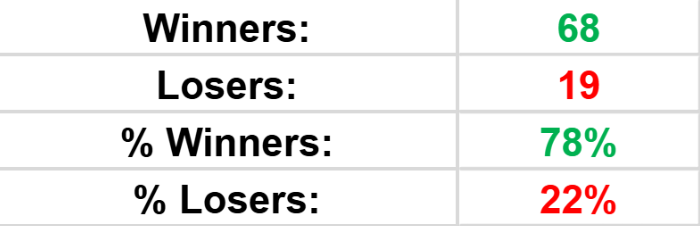
That’s like winning almost 8 out of every 10 trades.
If you trade Tesla, this is a moment worth understanding clearly.
So if you want all the details, including how you can jump on the very next opportunity…
See My TSLA Game Plan in Action
Disclaimer: We develop tools and strategies to the best of our ability, but we can’t guarantee the future. There is always a risk of loss when trading. Past performance is not indicative of future results. On live trades, the result is a 78% win rate from 4/05/23 through 2/20/26, with an average return per trade (winners and losers included) of 19.88%, a 6-day average hold time, and an average winner of 52.76%.


